
June 3, 2026
Next-generation headend without new hardware.
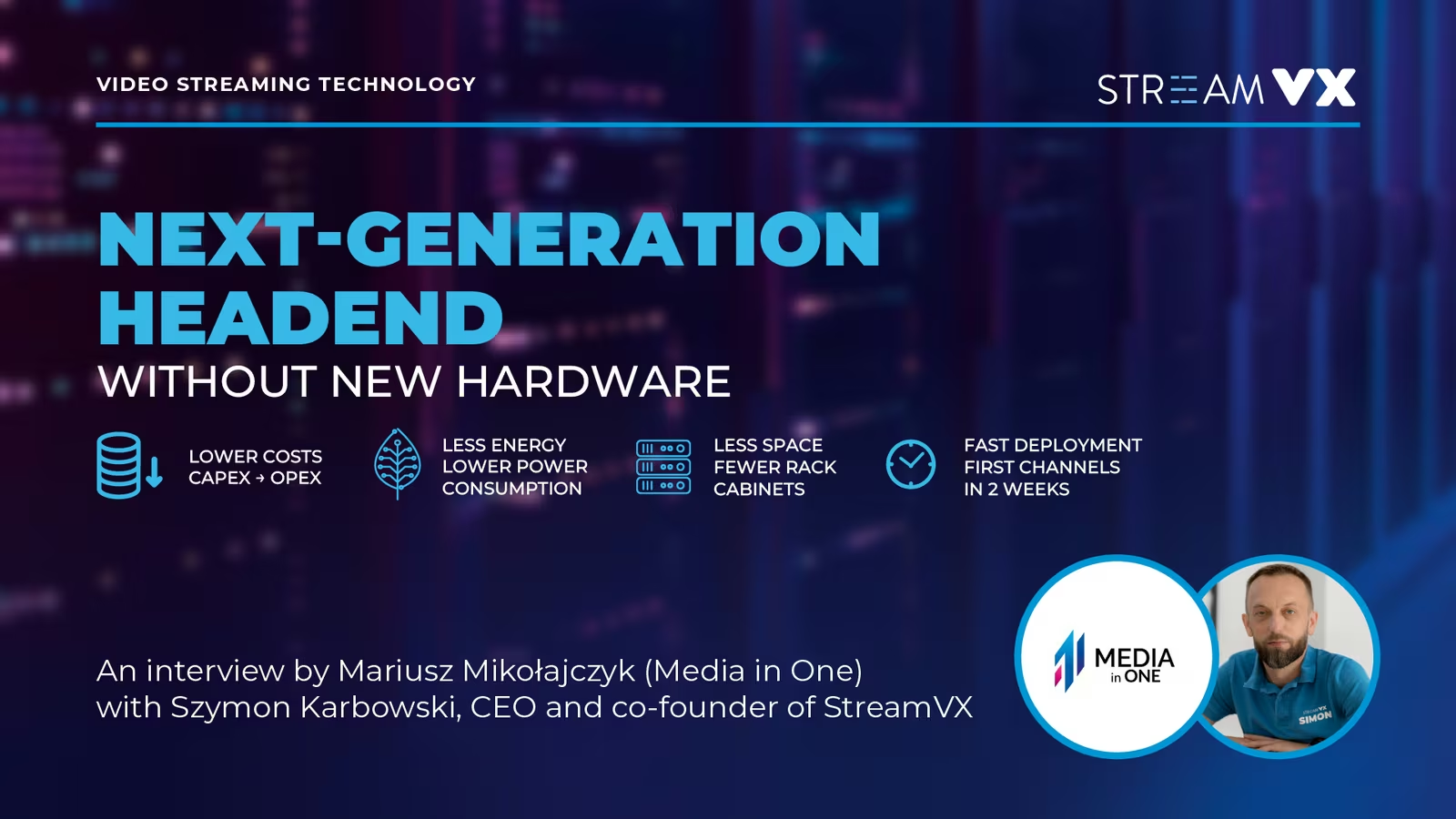
For twenty years the market accepted one rule: replace your dedicated headend platform every seven years. StreamVX inverts that logic. Its software replaces the classic headend entirely and runs on standard x86 servers, including the machines an operator already owns - for lower cost, less power, less space, and a go-live measured in weeks rather than months.
[Mariusz Mikołajczyk mediainone.pl] CATV operators in Poland are speaking with one voice: headend costs are rising and hardware vendors keep discontinuing platforms. How does StreamVX answer that?
[Szymon Karbowski] We invert the logic the market has lived with for two decades. An operator no longer has to buy a dedicated hardware platform every seven years. Our software - vxTranscoder, vxPackager, vxOrigin, vxCDN, vxDRM and the other components - completely replaces the classic headend. Everything runs on standard x86 servers, including the machines an operator already has in the rack.
A classic headend is dozens of dedicated boxes, each with its own power supply and fan, each performing one narrow function at 20–30% resource utilisation. That is a design from an era when electricity was cheap and rack space felt unlimited. A software-defined headend lets you run many functions on a single server. Fewer racks, less power, less cooling.
The classic headend-replacement model means a long project, high CAPEX and months of waiting. What does StreamVX offer instead?
We install in two weeks, and we spread payment over 24 or 36 months. After that period, the licence becomes the operator's property - this is not a lease, and it is not a perpetual subscription. The operator gets the latest technology immediately, without having to justify a large one-time investment to the board.
We turn CAPEX into predictable OPEX, and that OPEX is easy to offset from two sources: new revenue from OTT services and 4K packages, and operational savings - a lower electricity bill, less space in the server room, fewer hours for the technical team. After 24 or 36 months the operator isn't left running someone else's system - they are left with infrastructure they own.
The server and RAM market has gone wild - astronomical prices, terrible availability. How does StreamVX respond to that crisis?
The operator doesn't have to take part in it. Our software runs comfortably on three- or four-year-old Dell, HPE or Supermicro servers that the operator has already depreciated. A typical dual-socket server from four years ago still has 32 to 64 cores - enough to sustain several dozen real-time transcoding channels.
Most importantly, the StreamVX licence is hardware-independent. If in two or three years the operator swaps in newer servers - once RAM prices return to normal - we move the licences to the new machines. And because newer processors deliver so much more power, two of today's transcoders will fit on a single new server. The operator gains a second time, on consolidation. It's a model that rewards the operator for every year the system runs, rather than punishing them with another replacement.
And deployment? Operators are afraid of long migrations.
They're right to be afraid - they've seen too many projects drag on for a year. With us it looks different. We slot our system in parallel to the existing infrastructure, move channels across in stages, and the operator retires the old headend only when they are ready. The first channels run on StreamVX two weeks after signing; a full migration takes anywhere from a few weeks to three months. Rollback is possible at any moment. We handle the deployment - the operator needs neither a dedicated in-house team nor an external integrator.
After go-live, the support contract covers proactive monitoring and quarterly updates. The operator doesn't pay separately for every new feature - the next versions of vxTranscoder, vxPackager and vxStatMux are part of the service agreement. It's a system that grows with the operator, not one you have to renegotiate from scratch after a year.
Who is already running on StreamVX today?
In Poland - Canal+, TOYA and Asta-Net. Internationally - Megacable in Mexico, Medianet in the Maldives, Fibrazo in Colombia and Canella in the United States. Our technology runs from the Caribbean to Scandinavia, across cable, IPTV, OTT and hybrid networks.
For a Polish operator that matters for two reasons. First, we have deployment experience on live, commercial networks with millions of subscribers. Second, as a company from Gdańsk we are within arm's reach. A StreamVX engineer can be with an operator in Warsaw, Kraków or Poznań in minutes remotely, and physically within hours. No global vendor offers that kind of availability. And at night, when something is happening on a live headend, that is absolutely critical.
What's the biggest mental barrier among operators today?
The belief that "software-defined" means risk and an appliance means safety. Twenty-five years in this industry have taught me the exact opposite. An appliance means vendor lock-in, an EOL every few years and a bill the operator doesn't control. Software on your own server means technological sovereignty. At a time when every złoty of CAPEX is counted and cloud OPEX climbs month after month, this is no longer an ideological choice. It's a matter of economics.